The insurance sector is in a period of sustained transformation, driven by both internal pressures for efficiency and external demands for personalized, digital-first experiences. Carriers, MGAs, and brokers are navigating a complex landscape where legacy infrastructure often coexists with ambitious innovation roadmaps. The strategic imperative is clear: deliver modern digital products and services without the prohibitive cost and risk of wholesale core system replacement. This means focusing on intelligent overlays, API-first integrations, and modular enhancements that deliver tangible value quickly.
This incremental approach allows insurers to address critical pain points in underwriting, claims, and customer experience. The goal is to unlock data previously siloed, automate repetitive tasks, and empower both internal teams and external customers with intuitive tools. The focus is shifting from "digitalizing" existing paper processes to reimagining workflows and interactions from the ground up, leveraging advanced analytics and AI to drive better outcomes and stronger customer relationships.
Generative AI for Customer Service and Internal Knowledge
Streamlining interactions and information access with large language models.
Generative AI is moving beyond proof-of-concept to practical deployment in insurance, particularly in customer service and internal knowledge management. Carriers like Geico and Progressive are piloting AI chatbots, powered by models such as OpenAI's GPT-4o or Google's Gemini, to handle routine inquiries, provide policy information, and guide customers through initial claims steps. These systems aim to reduce call center volumes for simple tasks, freeing human agents to focus on complex cases requiring empathy and detailed problem-solving. Internally, large language models are being trained on vast repositories of policy documents, underwriting guidelines, and claims procedures, enabling agents and adjusters to quickly find precise answers, summarize complex cases, and even draft initial communications.
The impact extends to efficiency and consistency. For customers, it means faster access to information 24/7 without waiting on hold. For insurers, it translates into lower operational costs and improved agent productivity. For instance, an underwriter might use a GenAI tool to quickly synthesize risk factors from multiple data sources and draft a preliminary assessment, rather than manually sifting through disparate documents. While full automation of complex tasks remains distant, the ability of GenAI to process, understand, and generate human-like text is significantly accelerating information retrieval and basic communication across the insurance value chain.
What to do this quarter: Identify a specific, high-volume, low-complexity customer service use case (e.g., FAQ answering, basic policy status checks) or an internal knowledge retrieval challenge. Partner with a vendor or internal team to develop and pilot a GenAI-powered solution, focusing on precise prompt engineering and robust guardrails to ensure accuracy and compliance.
Embedded Insurance and Ecosystem Integration
Integrating insurance products seamlessly into third-party customer journeys.
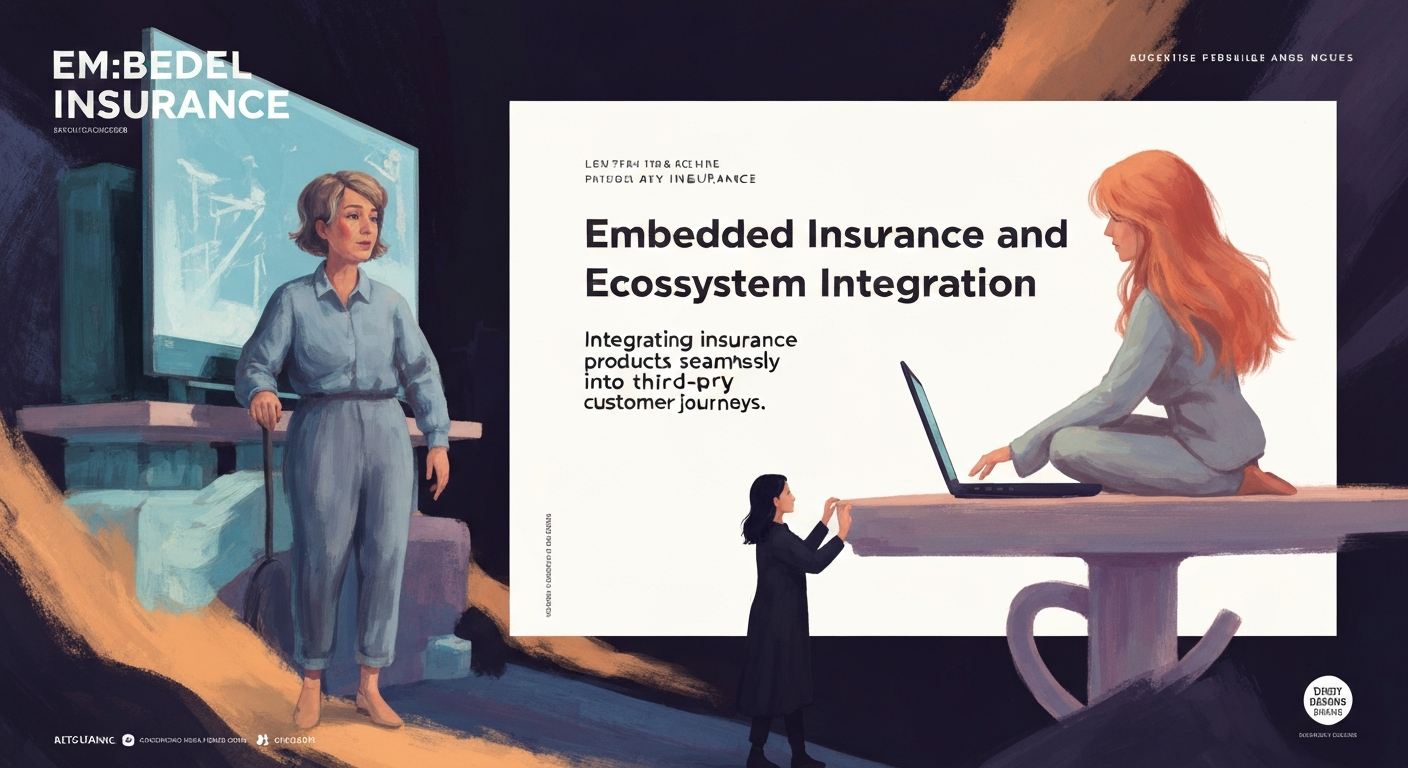
Embedded insurance is gaining traction as insurers seek new distribution channels and ways to meet customers at their point of need. Instead of traditional push sales, embedded models integrate insurance offerings directly into the purchase or usage journey of a related product or service. Examples include travel insurance offered at the point of flight booking, extended warranties during electronics checkout, or even usage-based auto insurance integrated into vehicle telematics platforms. Companies like Cover Genius and Setoo are prominent players enabling these integrations, providing APIs and platforms for insurers to connect with a wider array of digital partners.
This trend is driven by changing consumer expectations for convenience and personalized offerings. For insurers, it offers access to new customer segments and reduces acquisition costs by leveraging existing customer relationships of partner companies. It also allows for highly contextualized products, such as single-trip travel coverage or short-term event liability, which are difficult to distribute through traditional channels. The challenge lies in building robust, flexible API layers and establishing trust with diverse third-party platforms, ensuring data security and a seamless customer experience from purchase to claims.
What to do this quarter: Evaluate potential non-insurance partners whose customer journeys align with existing or new insurance products (e.g., e-commerce platforms, travel aggregators, financial service apps). Develop a pilot for a micro-insurance product that can be seamlessly embedded, focusing on API integration capabilities and a clear value proposition for the partner and their customers.
Advanced Data Analytics and Predictive Underwriting
Leveraging diverse data sources for more precise risk assessment and pricing.

Insurers are moving beyond traditional actuarial tables and credit scores, incorporating a wider array of alternative data sources to enhance underwriting accuracy and personalize pricing. This includes telematics data from vehicles (e.g., from Verisk or LexisNexis Risk Solutions), property data from satellite imagery and IoT sensors (e.g., from Zesty.ai or Cape Analytics), public records, and even behavioral data (with appropriate consent and regulatory compliance). Machine learning models are then applied to these datasets to identify subtle patterns and predict risk more accurately than ever before.
The primary benefit is a more granular understanding of risk, allowing insurers to offer more competitive and tailored premiums to low-risk customers, while accurately pricing for higher-risk profiles. This can lead to improved profitability, reduced fraud, and a fairer pricing structure for policyholders. For instance, a homeowner's insurer might use aerial imagery to assess roof condition and tree proximity, adjusting premiums accordingly without an in-person inspection. The challenge involves managing vast amounts of unstructured data, ensuring data quality, and navigating the ethical and regulatory considerations of using new data types, particularly around bias and privacy.
What to do this quarter: Identify a specific line of business (e.g., personal auto, homeowners) where current underwriting models are limited by data. Explore integrating one new, non-traditional data source (e.g., telematics, geospatial data) and apply basic machine learning techniques to assess its predictive power on a subset of policies.
Hyper-Personalization and Proactive Risk Mitigation
Delivering tailored experiences and preventative services throughout the policy lifecycle.

The move towards hyper-personalization extends beyond initial pricing to the entire policy lifecycle, emphasizing proactive engagement and risk mitigation. Insurers are leveraging data and AI to understand individual policyholder needs and preferences, offering customized recommendations, preventative services, and timely communications. For example, a health insurer might send personalized wellness tips based on a policyholder's health data (with consent), or a home insurer might provide alerts about impending severe weather and advice on protecting property.
This trend aims to shift the insurer-customer relationship from purely transactional to one of partnership in risk management. By helping customers prevent claims, insurers can reduce payouts and improve customer loyalty. Technologies enabling this include AI-driven recommendation engines, IoT devices providing real-time data (e.g., smart home sensors, wearables), and sophisticated customer relationship management (CRM) systems integrated with policy administration. The goal is to create a "sticky" relationship where the insurer is seen as a valuable partner in managing life's uncertainties, rather than just a claims processor.
What to do this quarter: Select a specific customer segment and identify a common risk they face. Design and pilot a proactive communication or service initiative using existing data, such as personalized weather alerts for homeowners or driving tips for auto policyholders, delivered through a preferred digital channel.
Regulatory Scrutiny on AI Ethics and Data Privacy
Navigating evolving regulations around AI transparency, fairness, and data use.
As AI and advanced analytics become central to insurance operations, regulatory bodies worldwide are increasing their scrutiny on AI ethics, transparency, and data privacy. Regulations like the EU AI Act, various state-level data privacy laws in the US (e.g., CCPA, CPRA), and evolving guidelines from bodies like the NAIC are forcing insurers to demonstrate that their AI models are fair, explainable, and free from unlawful bias. There's a particular focus on how AI impacts underwriting decisions, claims processing, and pricing, ensuring non-discriminatory outcomes.
This trend necessitates a robust governance framework for AI development and deployment. Insurers must be able to explain how their algorithms arrive at decisions (explainable AI or XAI), mitigate against historical data biases, and ensure customer data is collected, stored, and used in compliance with increasingly stringent privacy laws. Failure to comply can result in significant fines, reputational damage, and loss of consumer trust. Companies like Ethyca and DataRobot are offering tools to help organizations monitor AI models for bias and explain their outputs.
What to do this quarter: Conduct an internal audit of existing or planned AI/ML initiatives, focusing on data sourcing, model training, and decision-making processes. Identify potential areas of bias or lack of explainability, and begin developing a framework for AI governance that addresses regulatory requirements and ethical considerations.
How Hostreck thinks about this:
The insurance industry's future is defined by strategic, modular innovation that leverages emerging technologies to enhance existing systems, rather than wholesale replacement. We believe in building intelligent overlays and API-driven solutions that connect disparate systems, unlock data, and automate processes where it makes sense. The focus should always be on delivering measurable business value and improved experiences for both internal teams and end customers, ensuring that technological adoption aligns with clear strategic objectives and robust governance.