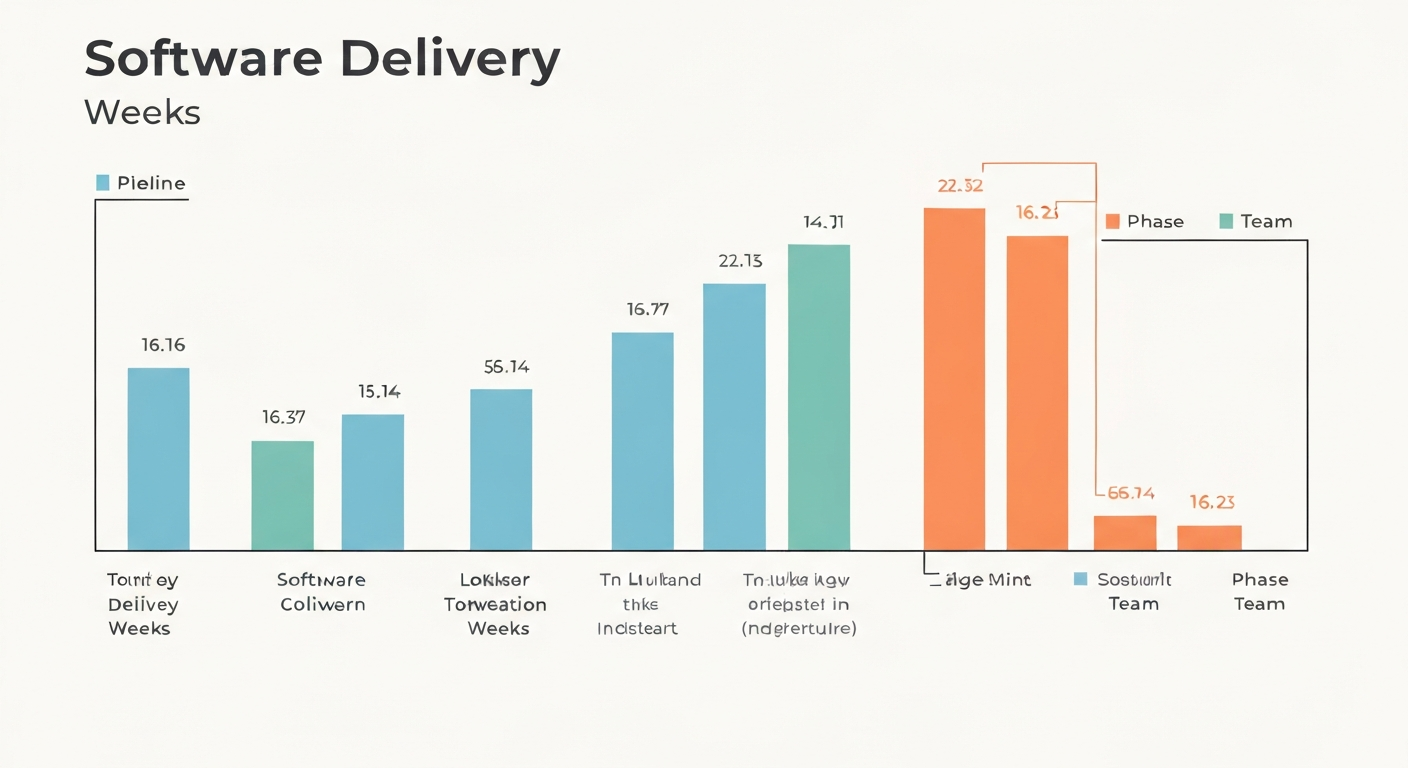
Teams frequently underestimate custom web development timelines because they focus on visible features rather than foundational elements. A login page seems simple until you account for secure authentication, password resets, multi-factor options, and integration with existing identity providers like Okta or Azure AD. This complexity often pushes an assumed four-week project into a three-month endeavor. The distinction between these two timelines often becomes clear very early on if you structure the first month correctly.
Week 0: Pre-flight
Before any code is written, a set of crucial artifacts must be in place. These ensure alignment and provide a stable target. Without them, even a small project will drift.
- Defined Scope (1-2 pages): A clear, concise document outlining the single most critical user flow the application will support within the first 30 days. This is not a comprehensive feature list. For an internal tool, it might be "User can log in and view their assigned tasks." For an external portal, "Customer can register and view their order history."
- User Personas (1 page): Brief descriptions of the primary users who will engage with the initial scope. Include their goals and pain points related to the specific feature being built.
- Key Performance Indicators (KPIs) (1-3 metrics): Measurable targets for the initial release. Examples include "50% reduction in manual data entry for X task" or "90% successful login rate."
- Technical Stack Decisions (Confirmed): Agreement on the core technologies: front-end framework (e.g., React, Vue), back-end language/framework (e.g., Node.js with Express, Python with Django, C# with .NET), database (e.g., PostgreSQL, MongoDB), and cloud provider (e.g., AWS, Azure, GCP). These decisions should be made with a clear understanding of existing infrastructure, team expertise, and long-term scalability goals.
- Design System/Component Library Strategy: A decision on whether to use an existing design system (e.g., Material-UI, Ant Design, Bootstrap) or if a minimal custom component set needs to be developed. For a 30-day project, leveraging an existing system is non-negotiable.
- Deployment Strategy (Confirmed): Outline how the application will be deployed and hosted. For example, containerization with Docker and deployment to AWS ECS or Azure App Service. This includes defining CI/CD tooling like GitLab CI or GitHub Actions.
Weeks 1-2: Foundations
The first two weeks are dedicated to establishing the core technical infrastructure and building the most critical, end-to-end user path. This phase prioritizes functionality over polish.

- Week 1: Infrastructure & Core API:
- Deliverable: A deployed, barebones application accessible via a URL, demonstrating basic authentication and a single data retrieval endpoint.
- Tools: Cloud provider (AWS, Azure, GCP), Docker, chosen CI/CD tool (e.g., GitHub Actions), back-end framework.
- Activities:
- Set up repository, CI/CD pipeline for automated testing and deployment.
- Configure core infrastructure (database, API gateway, compute service).
- Implement user authentication (e.g., JWT-based, OAuth2 via Auth0/Okta).
- Develop a single API endpoint that retrieves static data.
- Deploy the back-end service.
- Week 2: Front-end Integration & End-to-End Flow:
- Deliverable: A functional front-end application consuming the core API, allowing a user to log in and view data from the implemented endpoint.
- Tools: Chosen front-end framework (e.g., React), design system (e.g., Material-UI), back-end framework.
- Activities:
- Set up front-end project with chosen framework and design system.
- Develop login screen and integrate with back-end authentication.
- Build a simple data display component that consumes the API endpoint.
- Implement basic client-side routing.
- Deploy the front-end application, linking it to the back-end.
- Conduct initial end-to-end testing of the defined critical user flow.
Weeks 3-4: Shipping the First Slice
This period focuses on refining the implemented core flow, adding essential user experience elements, and preparing for a soft launch. The goal is a usable, stable product for the defined initial scope.

- Week 3: UX Refinement & Essential Features:
- Deliverable: The core user flow is polished, incorporating user feedback, and includes basic error handling and validation.
- Activities:
- Gather feedback from internal stakeholders on the deployed application.
- Implement input validation and clear error messages for the critical flow.
- Add basic navigation and state management.
- Improve accessibility for the core components.
- Implement necessary monitoring and logging for the deployed services (e.g., Sentry, Datadog).
- Week 4: Testing, Documentation & Deployment for Launch:
- Deliverable: A stable, tested, and documented application ready for internal or limited external release.
- Activities:
- Conduct comprehensive integration and user acceptance testing for the defined scope.
- Write user-facing documentation for the initial feature set.
- Prepare deployment artifacts and finalize release notes.
- Perform a final deployment to the production environment, or the designated staging environment for soft launch.
- Communicate readiness for initial user onboarding.
Signs you're a 30-day project / Signs you're a 90-day project
Signs you're a 30-day project:
- The initial scope is a single, linear user flow with minimal branching logic.
- You are leveraging an existing design system and not building custom UI components from scratch.
- Authentication is handled by an existing identity provider (e.g., Okta, Azure AD) or a simple, well-understood mechanism.
- Data models are straightforward, with few relationships or complex business rules.
- No legacy system integrations are required for the initial release.
- The team has high familiarity with the chosen technology stack.
- No significant security compliance (e.g., HIPAA, PCI-DSS) is needed for the initial slice.
Signs you're a 90-day project:
- The initial scope involves multiple complex user roles, permissions, or branching workflows.
- A significant portion of the UI requires custom design and component development.
- The project demands complex integrations with multiple legacy systems, requiring custom API wrappers or data transformations.
- Data models are highly normalized, with many-to-many relationships and intricate business logic.
- The team needs to learn a new technology stack or significantly ramp up on specific tooling.
- Strict regulatory compliance (e.g., HIPAA, PCI-DSS) is a day-one requirement, impacting architecture and development processes.
- There's no clear, single decision-maker for scope or technical direction.
After the initial launch, maintaining momentum is crucial. Continuously gather user feedback and prioritize subsequent features based on real-world usage data and defined KPIs. Implement an agile iteration cycle, breaking down larger features into smaller, deployable chunks. This approach ensures the application evolves with user needs while maintaining a predictable development cadence, preventing scope creep from derailing future progress.