The insurance sector is in a period of significant digital evolution. Carriers, MGAs, and brokers are focused on improving efficiency and customer satisfaction, often by integrating new technologies with existing infrastructure rather than undertaking complete overhauls. The pressure comes from both customer expectations for seamless digital interactions and internal demands for more precise risk assessment and faster claims processing.
This environment means that technology adoption isn't just about innovation; it's about strategic modernization. Insurers are looking for solutions that provide immediate value in areas like underwriting accuracy, claims automation, and personalized customer engagement, all while minimizing disruption to their core policy administration systems. The goal is to build a more agile and data-driven operation, capable of responding to market shifts and regulatory changes with greater speed.
Generative AI in Claims and Customer Service
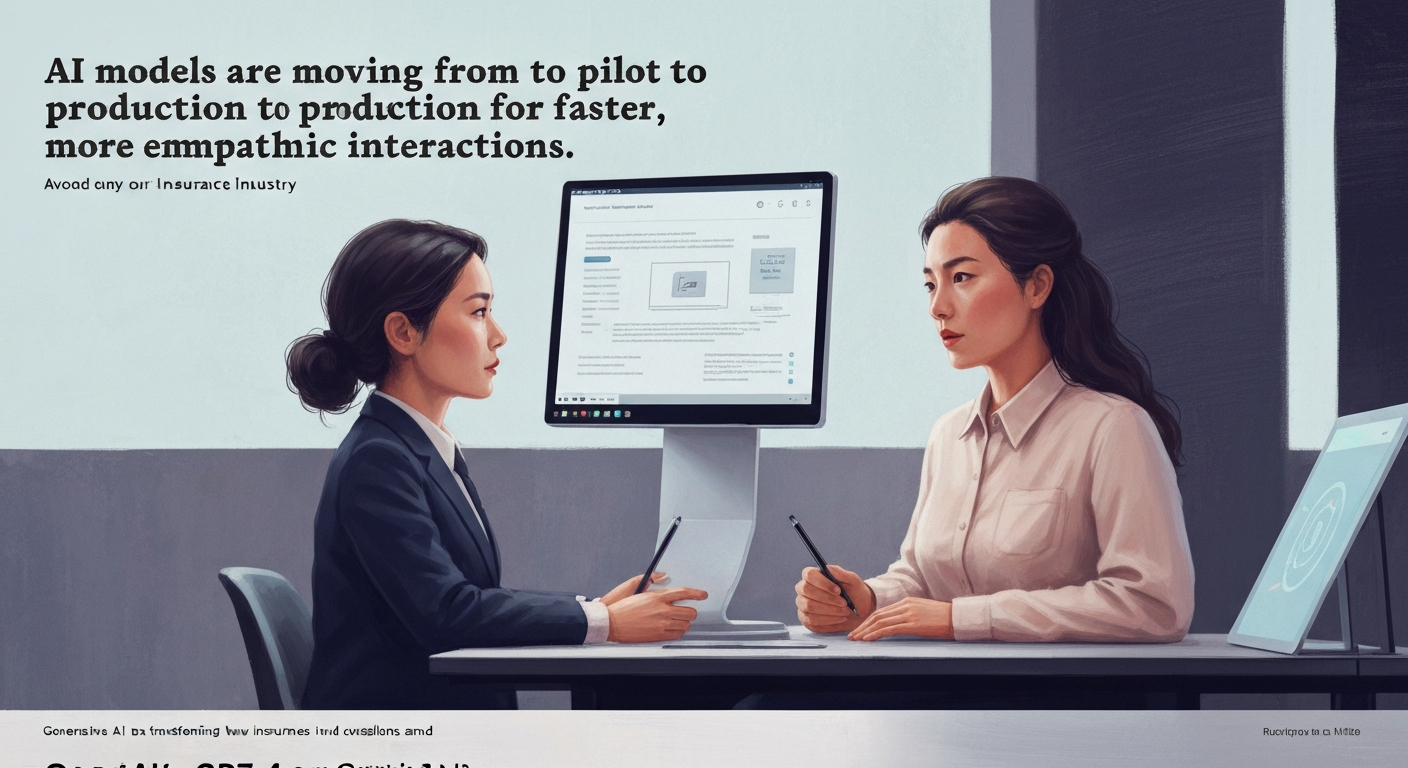
AI models are moving from pilot to production for faster, more empathetic interactions.
Generative AI is transforming how insurers handle claims and customer inquiries. Instead of rule-based chatbots, we now see systems like OpenAI's GPT-4o or Google's Gemini Pro being integrated into customer service platforms. These models can understand natural language, synthesize information from policy documents, and generate personalized responses for common queries, ranging from policy coverage explanations to claims status updates. For example, a customer interacting with a virtual assistant can receive a detailed explanation of their deductible or the next steps in their claim process, pulling real-time data from backend systems. This reduces call center volume and improves customer satisfaction by providing instant, accurate information.
Beyond customer-facing applications, generative AI is also enhancing internal claims processing. Adjusters are using AI-powered tools to summarize complex medical reports, review loss estimates, and identify discrepancies in claim submissions. Platforms like Tractable are already using AI for visual damage assessment in auto claims, but generative AI extends this by interpreting unstructured text data from incident reports or witness statements. This capability allows adjusters to focus on complex cases requiring human judgment, while routine tasks are automated, leading to faster claim resolution times and reduced operational costs. The shift is from AI assisting with data extraction to AI generating actionable insights and communications.
What to do this quarter: Identify a specific, high-volume customer service or claims inquiry workflow. Pilot a generative AI solution, focusing on integrating a large language model (LLM) with your existing knowledge base and policy data, to automate responses for a subset of those inquiries. Measure deflection rates and customer satisfaction scores.
Embedded Insurance and Ecosystem Partnerships
Insurance products are becoming seamlessly integrated into non-insurance purchase journeys.
Embedded insurance continues its growth trajectory, moving beyond simple purchase protection to more sophisticated offerings integrated at the point of sale for various products and services. Companies like Cover Genius and Qover are facilitating these integrations, allowing non-insurance businesses – from e-commerce platforms and travel agencies to automotive manufacturers – to offer relevant insurance products directly to their customers. For example, a car buyer might be offered tailored auto insurance during the vehicle financing process, or a traveler could purchase trip cancellation coverage directly within their flight booking app. This approach capitalizes on existing customer trust and purchase intent, making insurance acquisition frictionless.
This trend is driven by the desire for improved customer experience and new revenue streams for non-insurers, while insurers gain access to new distribution channels and customer segments. The underlying technology often involves APIs that allow real-time policy quoting, issuance, and claims submission to be embedded into third-party platforms. This requires insurers to have robust, API-first product architectures and a willingness to collaborate closely with partners. Regulatory bodies, such as the NAIC in the U.S. and EIOPA in Europe, are also starting to issue guidance on data sharing and consumer protection in these integrated ecosystems, signaling a maturing market.
What to do this quarter: Evaluate your existing product portfolio for components that could be repackaged or simplified for embedded distribution. Identify one strategic non-insurance partner whose customer journey aligns with a specific insurance offering (e.g., home warranty for appliance retailers, travel insurance for tour operators) and initiate discussions on API integration feasibility.
Advanced Predictive Analytics in Underwriting

AI and machine learning are refining risk assessment with granular, real-time data.
Underwriting is undergoing a significant transformation, driven by advanced predictive analytics and machine learning models. Insurers are moving beyond traditional actuarial tables and credit scores to incorporate a much wider array of data points, including telematics data for auto insurance, IoT sensor data for property and health, and even publicly available demographic or behavioral data (within regulatory limits). Companies like Zesty.ai are providing property risk scores based on aerial imagery and climate data, allowing home insurers to assess wildfire or flood risk with unprecedented precision. This allows for more personalized pricing, reducing adverse selection and improving profitability.
The shift is towards dynamic, real-time underwriting. Instead of fixed annual policies, some insurers are exploring usage-based or event-triggered coverage, where premiums adjust based on current risk factors. For instance, commercial auto insurers are leveraging fleet telematics from vendors like Samsara to offer premiums that reflect actual driving behavior and vehicle maintenance. This approach demands robust data pipelines, sophisticated machine learning algorithms (e.g., gradient boosting machines, neural networks), and the ability to integrate external data sources securely and compliantly. The regulatory landscape, particularly around data privacy (e.g., GDPR, CCPA) and algorithmic bias, remains a critical consideration.
What to do this quarter: Audit your current underwriting data sources and identify at least two new, non-traditional data sets (e.g., publicly available geospatial data, anonymized social media sentiment, or IoT device data) that could enhance risk assessment for a specific product line. Develop a proof-of-concept model to test their predictive power against your current metrics.
Low-Code/No-Code for Business Agility
Business users are empowered to configure and deploy digital solutions without deep coding skills.
Low-code and no-code platforms are gaining significant traction within the insurance industry, addressing the persistent challenge of IT backlogs and the need for faster digital product development. Platforms from vendors like Appian, OutSystems, and Microsoft Power Apps enable business analysts and subject matter experts to build and deploy applications, workflows, and customer portals using visual interfaces, drag-and-drop components, and pre-built templates. This allows insurers to rapidly prototype and launch new digital experiences, such as self-service policy amendment tools or agent productivity dashboards, without requiring extensive involvement from core development teams.

This capability is particularly impactful for modernizing legacy processes without ripping out core policy administration systems. For example, an MGA can quickly build a new agent portal to streamline quoting and policy issuance for a niche product, integrating via APIs with their existing backend systems. This significantly reduces time-to-market for new initiatives, fosters greater collaboration between business and IT, and allows IT resources to focus on complex, strategic development. The governance of these platforms, ensuring security, scalability, and adherence to enterprise architecture standards, is a key consideration for successful adoption.
What to do this quarter: Identify a specific, repetitive manual process within your operations (e.g., a data entry task, a multi-step approval workflow). Pilot a low-code/no-code platform to digitize and automate this process, involving business users in the development from the outset. Measure the efficiency gains and user adoption.
Regulatory Focus on Data Ethics and Algorithmic Transparency
Regulators are increasing scrutiny on how AI is used, demanding fairness and explainability.
As insurers increasingly rely on AI and machine learning for everything from underwriting to claims processing and fraud detection, regulatory bodies are intensifying their focus on data ethics and algorithmic transparency. Concerns about potential bias in AI models, particularly in areas like pricing and claims denial, are prompting new guidelines and legislative proposals. For example, the EU's AI Act, set to take full effect, categorizes AI systems by risk level, with "high-risk" applications like those in insurance subject to stringent requirements for data quality, human oversight, and explainability. Similarly, U.S. states are exploring legislation related to algorithmic fairness in insurance.
Insurers are now expected to demonstrate that their AI models are fair, non-discriminatory, and that their decisions can be explained. This requires robust data governance frameworks, comprehensive model validation processes, and tools for explainable AI (XAI) that can articulate why a particular decision was made. Simply put, "black box" algorithms are no longer acceptable for high-stakes applications. Compliance departments are working closely with data science teams to ensure models adhere to principles of fairness, accountability, and transparency, often leveraging open-source tools like IBM's AI Fairness 360 or Google's What-If Tool to audit model behavior.
What to do this quarter: Conduct an internal audit of one existing AI model used in a critical decision-making process (e.g., pricing, risk scoring). Focus on identifying potential sources of bias in the training data and assessing the model's explainability. Develop a plan to implement a basic XAI framework or a bias detection toolkit.
How Hostreck thinks about this
The current landscape demands an approach that balances innovation with pragmatism. Rather than wholesale system replacements, the focus is on augmenting existing core systems with targeted, modular solutions. This means developing new digital experiences, AI-driven automation, and data analytics layers that integrate seamlessly, providing immediate value without disrupting critical operations. Our view is that strategic modernization allows insurers to adapt quickly, improve customer and agent experiences, and enhance profitability by leveraging technology where it has the most impact.