Founders and product leaders often face a critical choice: invest in broad service and product design or focus specifically on e-commerce development. Both avenues promise enhanced user experience and business growth, but they address fundamentally different problems with distinct approaches. Understanding which path aligns with your immediate strategic goals and long-term vision is crucial for effective resource allocation and achieving measurable results. This isn't about which is "better," but which is right for your current stage and objective.
What Service & Product Design actually does
Service and Product Design at Hostreck encompasses the end-to-end process of creating or refining a user experience, whether it's for a digital product, a physical service, or an integrated system. We start with deep user research, conducting ethnographic studies, interviews, and usability testing to uncover true pain points and unmet needs. This informs the entire design process, from defining information architecture and user flows to crafting wireframes and high-fidelity prototypes. Our work extends to visual design, including brand identity, UI design, and design systems, ensuring consistency and aesthetic appeal across all touchpoints. We might design a new patient portal for a healthcare provider, revamp the internal logistics platform for a supply chain company, or create the interface for an AI-powered analytics tool. The core output is a meticulously designed, validated experience that solves a specific user problem and achieves defined business objectives, often preceding or running in parallel with software development.
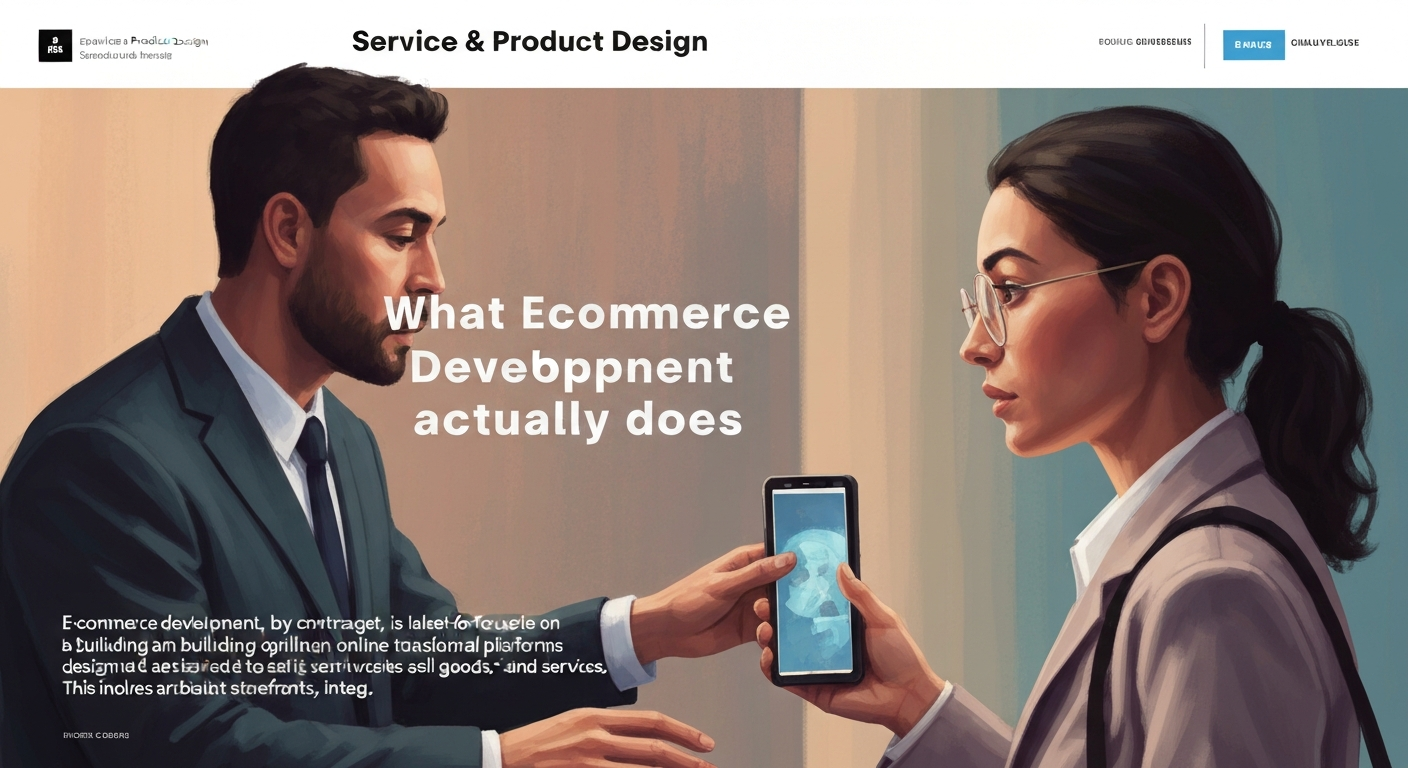
What Ecommerce Development actually does
E-commerce development, by contrast, is laser-focused on building and optimizing online transactional platforms designed to sell goods or services. This involves architecting robust storefronts, integrating secure payment gateways, and implementing inventory management systems. We specialize in custom e-commerce solutions built on platforms like Shopify Plus, leveraging its ecosystem for rapid deployment and scalability, or developing headless commerce architectures using frameworks like Next.js and a backend like commercetools for maximum flexibility and performance. Our focus is on conversion rate optimization, streamlining checkout flows, personalizing user experiences, and ensuring the technical infrastructure can handle high traffic and complex product catalogs. For example, we might build a custom subscription box service, re-platform a retail brand's global storefront, or integrate AI-driven product recommendations into an existing Shopify site. The primary goal is to create a high-performing sales channel that drives revenue and scales with business demand.
When Service & Product Design is the right call
- You need to define or redefine a core offering: If you're launching a new digital product or service, or your existing offering has low adoption/satisfaction despite good functionality, design research and strategy will clarify the true user need and shape the solution.
- Your user experience is inconsistent or fragmented: When users encounter different interfaces, brand messaging, or service levels across various touchpoints (web, mobile, in-person), service and product design unifies these into a cohesive, intuitive journey.
- You're building an internal tool or platform: For B2B applications, enterprise software, or internal operational systems, user-centric design ensures employees are productive and engaged, reducing training costs and improving data quality.
- Innovation requires deep user insights: If you're exploring entirely new markets or solving complex, undefined problems, design-led research uncovers opportunities and validates concepts before committing to expensive development cycles.
- Your brand identity needs a digital refresh: When the visual language or overall brand perception no longer resonates with your target audience, comprehensive design work can rebuild trust and appeal across all digital assets.
When Ecommerce Development is the right call
- Your primary goal is to sell products online: If your business model relies on direct-to-consumer sales and you need a robust, scalable platform to facilitate transactions, e-commerce development is the direct path.
- You need to optimize an existing online store: If your current e-commerce platform suffers from low conversion rates, slow loading times, or inadequate scalability, focused development can address these specific performance bottlenecks.
- You require complex integrations for sales: When your online store needs to connect with sophisticated ERP systems, CRM platforms, third-party logistics, or custom loyalty programs, e-commerce development handles these technical requirements.
- You are launching a new product line with a clear sales channel: If you have a defined product, target audience, and a clear path to market via online sales, investing in a high-converting e-commerce platform accelerates revenue generation.
- You need flexible, future-proof sales architecture: For brands anticipating rapid growth, diverse sales channels (e.g., social commerce, marketplaces), or unique content-driven commerce, headless e-commerce provides the necessary architectural freedom.
Common pitfalls when teams pick the wrong one
- Building a beautiful, unusable store: Investing heavily in e-commerce development without prior service and product design can result in a technically sound platform that fails to resonate with users. The store might look good, but if the product discovery is unintuitive, the checkout process confusing, or the overall experience doesn't meet user expectations, conversions will remain low. This is like building a high-performance engine for a car with no steering wheel.
- Designing a service with no monetization path: Conversely, focusing solely on service and product design for a business that should be transactional can lead to elegant solutions that lack a clear conversion mechanism. You might have a delightful user journey, but if it doesn't seamlessly integrate payment, inventory, and order fulfillment, it becomes an expensive experience rather than a revenue driver. The "product" is designed, but the "store" is missing.
- Wasting resources on features nobody needs: Without the foundational user research inherent in service and product design, e-commerce development can fall into the trap of building features based on assumptions or competitor analysis, rather than validated user needs. This leads to scope creep, budget overruns, and a bloated platform that confuses users and complicates maintenance. You end up with a high-spec platform with low adoption of key features.
If your core challenge is defining what to build and how users will interact with it across various touchpoints, invest in Service & Product Design. If you already know what you want to sell and your primary need is a robust, high-converting digital storefront to facilitate those transactions, then Ecommerce Development is your clear priority. Do not conflate a user-friendly e-commerce experience with comprehensive service design; while they overlap, their strategic starting points and primary deliverables are distinct.